

Volkswagen Catalytic Converter Replacement Cost
How to Recover Value From Your Old Volkswagen Catalytic Converter

Replacing a Volkswagen catalytic converter can be a surprisingly expensive repair. Whether you drive a Jetta, Golf, GTI, Atlas, Tiguan, or another VW model, replacement costs can range from around $1,000 to several thousand dollars depending on the vehicle, model year, engine, and emissions system.
Volkswagen OEM catalytic converters removed during the repair may still contain valuable precious metals. Instead of automatically leaving the old converter behind, you may be able to sell it and recover some of the money spent on the replacement.
In this guide, you’ll learn:
- How much does a Volkswagen catalytic converter replacement cost?
- Why VW catalytic converters are expensive
- How to identify an OEM Volkswagen catalytic converter
- Why do some Volkswagen converters also have Audi markings?
- What laws may apply when selling a catalytic converter
- How to recover value from your old VW catalytic converter through RRCats
How Much Does It Cost to Replace a Volkswagen Catalytic Converter?
Volkswagen catalytic converter replacement costs can vary considerably depending on the vehicle.
Factors that affect the final replacement cost include:
- Volkswagen model and model year
- Engine configuration
- Labor and installation
- OEM versus aftermarket replacement parts
- State emissions requirements
- Additional exhaust repairs
- Number and location of emissions components
Learn more in our complete Volkswagen Catalytic Converter Replacement Cost Guide.
Why Your Volkswagen Catalytic Converter Is Important
Your catalytic converter is an important part of your Volkswagen’s emissions system.
As exhaust passes through the converter, it helps transform harmful exhaust gases into less harmful emissions before they leave the tailpipe.
A properly functioning catalytic converter helps your VW:
- Meet emissions requirements
- Reduce harmful pollutants
- Maintain proper engine operation
- Prevent emissions-related warning lights
- Pass required emissions inspections
If the catalytic converter fails or becomes damaged, your vehicle may experience performance problems, increased emissions, warning lights, or a failed inspection.
Why Volkswagen Catalytic Converter Replacement Is So Expensive
One reason catalytic converters are expensive is the precious metals they contain.
These commonly include:
- Platinum
- Palladium
- Rhodium
These materials help create the chemical reactions necessary to reduce harmful exhaust emissions.
Volkswagen also uses different converter and emissions-system designs across its lineup. The catalytic converter used on an Atlas may be considerably different from one found on a Jetta, Golf, or GTI.
That’s one reason replacement costs can vary so significantly between Volkswagen models and model years.
Read more about replacement pricing in our Volkswagen Catalytic Converter Replacement Cost Guide.
Can You Get Money Back From Your Old Volkswagen Catalytic Converter?
Yes.
Even when an original OEM Volkswagen catalytic converter can no longer properly control emissions, it may still contain recoverable precious metals.
That can give the old converter recycling value.
The amount your Volkswagen catalytic converter may be worth depends on factors including:
- VW model
- OEM versus aftermarket construction
- Serial number
- Converter design
- Physical condition
- Current precious metal markets
Because Volkswagen uses many different catalytic converter designs, properly identifying the unit is important before determining its value.
Learn how to sell your Volkswagen catalytic converter through RRCats.
Ask Your Mechanic to Return Your Original Converter
If your Volkswagen is having its catalytic converter replaced, talk to your repair shop before the work begins.
Ask them to return the original OEM converter to you after the repair.
Some repair facilities automatically recycle removed catalytic converters, so waiting until after the repair may be too late.
Helpful questions include:
- Can I have my original catalytic converter back?
- Will every converter removed from my vehicle be returned?
- Does your shop normally recycle old catalytic converters?
- Is there any repair paperwork I should keep?
Keeping your original converter gives you the opportunity to have it properly identified and determine whether it still has recycling value.
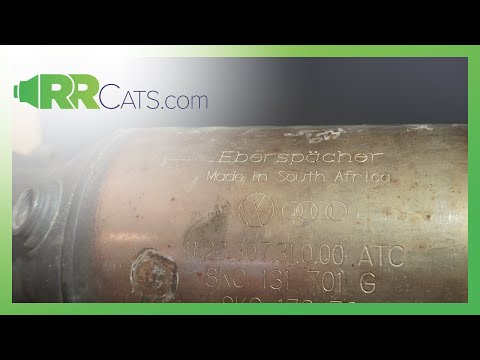
Scrap Volkswagen & Audi Catalytic Converters
Tom explores all of the serial number options when it comes to Volkswagon & Audi catalytic converters. To get a quote, send clear photos of your Volkswagen converter — including serial numbers when possible — using the form below or by text. Our team will give you the most accurate quote possible.
How to Identify Your Volkswagen Catalytic Converter
Volkswagen catalytic converters have several useful characteristics that can help with identification.
One of the most important is the serial number.
VW commonly uses alphanumeric serial numbers, meaning the identifying code contains both letters and numbers.
Examples include:
- 1K0 131 701 BQ
- 4G0 131 765 C
- 5Q0 131 701 N
- 1K0 131 701 BS
You may also find a VW logo stamped directly onto the converter.
However, there’s another detail that sometimes surprises Volkswagen owners.
Why Does My Volkswagen Converter Have an Audi Logo?
Volkswagen and Audi are part of the same automotive group and can share components and converter designs.
As a result, you may find both VW and Audi logos or markings on certain catalytic converters.
That doesn’t necessarily mean you have the wrong converter.
The serial numbers and other identifying markings help our team determine exactly which unit you have.
What If My VW Converter Has Multiple Serial Numbers?
This is especially important with Volkswagen catalytic converters.
Some units can have multiple numbers stamped onto the converter.
Don’t try to guess which number is the important one.
Instead:
- Photograph the complete catalytic converter
- Take close-up pictures of each serial number
- Photograph any VW or Audi logos
- Send every number you find to RRCats
Those different markings can provide useful information when identifying the converter and determining its precious-metal recovery profile.
VW Tip
If you find multiple serial numbers, send them all.
Don’t assume one number is more important than another. Clear photos of every stamped code give our team the best information for accurately identifying and quoting your converter.
Visit our Volkswagen Catalytic Converter Identification Guide for additional identification tips.
VW Brand Guide
Is It Legal to Sell a Volkswagen Catalytic Converter?
Catalytic converter laws vary by state.
Depending on where you live, sellers may be required to provide documentation such as:
- Proof of ownership
- Government-issued identification
- Vehicle registration or title
- Repair documentation
- Additional ownership records
These regulations are intended to establish lawful ownership and combat catalytic converter theft.
RRCats follows applicable purchasing and documentation requirements when buying catalytic converters.
Learn more about these laws below.
Catalytic Converter Laws by State
How to Sell Your Volkswagen Catalytic Converter With RRCats
Selling your Volkswagen catalytic converter is straightforward.
Step 1: Find the Serial Numbers
Inspect the converter for alphanumeric serial numbers and identifying markings.
If you find several numbers, photograph all of them.
Step 2: Take Clear Photos
Take pictures of the complete converter along with close-ups of:
- Serial numbers
- VW logos
- Audi logos
- Other stamped markings
Step 3: Request a Quote
Submit the photos and serial numbers through our online quote form or text them directly to our team.
Step 4: Ship Your Converter
Once you accept your quote, follow the shipping instructions provided by RRCats.
Step 5: Receive Payment
After your converter is received, verified, and processed, payment can be issued through the available payment options.
How Does It Work?
How Do I Ship?
Can I keep my old Volkswagen catalytic converter after replacement?
In many cases, you can ask the repair facility to return the original converter. Make the request before work begins because some shops routinely recycle removed catalytic converters.
Does an old Volkswagen catalytic converter still have value if it no longer works?
Potentially. A failed OEM converter can still contain recoverable platinum, palladium, and rhodium. Its actual recycling value depends on the specific converter and current precious-metal markets.
Where can I find the serial number on a Volkswagen catalytic converter?
VW catalytic converters commonly have alphanumeric serial numbers stamped directly onto the unit. Look over the entire converter and photograph every identifying number you find.
Why does my Volkswagen catalytic converter have an Audi logo?
Volkswagen and Audi share a parent automotive group and can use related components and converter designs. Finding VW and Audi markings on similar units isn’t unusual.
What if there are several serial numbers?
Send all of them. Multiple stamped numbers can help RRCats correctly identify the exact converter rather than relying on a single code.
Are OEM Volkswagen catalytic converters worth more than aftermarket converters?
OEM converters can have greater recycling value than many aftermarket units because their precious-metal loading and construction differ. However, the value should be determined from the specific converter rather than assuming every OEM VW converter has a particular value.
Ready to Get a Quote?
Please fill out the form below or text us pictures to get a custom quote for your VW converter.
Text Us for Quote

Send Text* →
*By Texting, you agree to our Terms & Conditions, including PayPal Fees