


Volkswagen Catalytic Converter Replacement Cost
A Realistic Guide To Replacing Your VW Catalytic Converter

If your Volkswagen needs a new catalytic converter, the repair can quickly become expensive. Replacement costs vary considerably between models like the Jetta, Golf, GTI, and Atlas, as well as by model year, engine configuration, and the type of replacement converter used.
The good news is that your original OEM Volkswagen catalytic converter may still have recycling value after it is removed. Before your repair shop disposes of it, asking for the original converter back could give you an opportunity to recover some of your replacement expense.
In this guide, you’ll learn:
- Average Volkswagen catalytic converter replacement costs
- Why VW catalytic converters can be expensive
- OEM vs. aftermarket replacement options
- Additional repair costs you may encounter
- How to recover money from your original converter
Average Volkswagen Catalytic Converter Replacement Cost
The cost of replacing a Volkswagen catalytic converter depends heavily on the specific vehicle.
Below are estimated replacement costs for several popular Volkswagen models.
| Volkswagen Model | Estimated Replacement Cost* |
|---|---|
| Volkswagen Atlas | $1,477–$1,647 |
| Volkswagen Golf | $3,099–$3,178 |
| Volkswagen GTI | $2,536–$2,651 |
| Volkswagen Jetta | $2,317–$2,409 |
*Estimated replacement costs are based on national RepairPal averages and generally include parts and labor.
The large difference between models is a good example of why there isn’t one universal “Volkswagen catalytic converter replacement cost.” Your specific vehicle and exhaust system matter.
Why Are Volkswagen Catalytic Converters So Expensive?
Catalytic converters are expensive because of the valuable material used inside them.
They commonly contain precious metals such as:
- Platinum
- Palladium
- Rhodium
These metals help convert harmful exhaust gases into less harmful emissions.
Volkswagen also uses different emissions systems across its lineup. The converter and exhaust configuration on a Jetta may differ significantly from that used on a Golf, GTI, Atlas, or another VW.
Other factors affecting replacement costs can include:
- OEM parts pricing
- Engine configuration
- Converter location
- Labor requirements
- Parts availability
- State emissions requirements
Together, these factors can push certain Volkswagen catalytic converter replacements into the several-thousand-dollar range.
OEM vs. Aftermarket Volkswagen Catalytic Converters
If your Volkswagen needs a replacement catalytic converter, one of the decisions you may face is whether to install an OEM or aftermarket unit.
OEM Volkswagen Catalytic Converters
OEM (Original Equipment Manufacturer) converters are designed for the vehicle’s original emissions system.
Advantages
- Designed for the specific VW application
- Factory-style fit
- Built to original emissions specifications
- Consistent construction and performance
Disadvantages
- Typically more expensive
- Availability can vary by model and model year
Aftermarket Volkswagen Catalytic Converters
Aftermarket converters are manufactured by third-party companies.
Advantages
- Generally lower upfront cost
- Multiple replacement options
- Often readily available
Disadvantages
- Quality can vary
- Fit and longevity can differ
- Not every converter meets every state’s emissions requirements
- Precious-metal content may differ from the original OEM converter
Before selecting an aftermarket converter, confirm that the part is compatible with your specific Volkswagen and meets the emissions requirements in the state where your vehicle is registered.
For more information on this, read on here: OEM vs Aftermarket Catalytic Converters
Additional Volkswagen Catalytic Converter Repair Costs
The replacement converter itself isn’t necessarily the only expense.
Depending on the condition of your Volkswagen, additional repairs may be necessary:
- Labor and installation
- Oxygen sensor replacement
- Repairs, welding, or fabrication work
- Theft-related damage repairs
Can You Reduce or Offset Your Replacement Cost?
You may not be able to avoid the repair, but you could recover some money by having the converter removed.
Your original OEM Volkswagen catalytic converter may still have recycling value even if it no longer works properly.
That’s because a failed converter can still contain recoverable platinum, palladium, and rhodium.
Before your mechanic begins the repair, ask:
“Can I have my original catalytic converter back?”
Don’t wait until after the repair. Some shops routinely recycle old catalytic converters after removal.
Once you have the original converter, you can have it identified and quoted to see what it may be worth.
Sell your Volkswagen catalytic converter
How Does It Work?
How Do I Ship?
Scrap Volkswagen & Audi Catalytic Converters
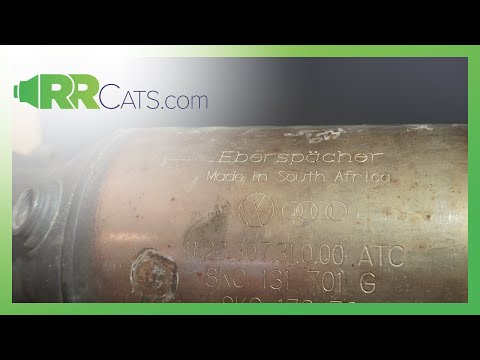
Tom explores all of the serial number options when it comes to Volkswagon & Audi catalytic converters. To get a quote, send clear photos of your Volkswagen converter — including serial numbers when possible — using the form below or by text. Our team will give you the most accurate quote possible.
How to Identify Your Original Volkswagen Catalytic Converter
Proper identification is particularly important with VW converters.
Volkswagen commonly uses alphanumeric serial numbers, which combine letters and numbers.
Examples include:
- 1K0 131 701 BQ
- 4G0 131 765 C
- 5Q0 131 701 N
- 1K0 131 701 BS
You may also find a VW or Audi logo stamped onto the converter.
Volkswagen and Audi are part of the same automotive group and can share components, so seeing Audi markings on a converter doesn’t necessarily mean it isn’t associated with a Volkswagen application.
Your VW May Have Multiple Serial Numbers
Some Volkswagen catalytic converters have more than one identifying number stamped onto them.
Don’t try to determine which one is the serial number yourself.
Instead:
- Take a picture of the complete converter
- Photograph every number you find
- Include VW and Audi logos in your photos
- Send everything to RRCats
Those markings can help our team correctly identify and grade the converter.
Visit our Volkswagen Catalytic Converter Identification Guide for more examples.
Is It Legal to Sell Your Old Volkswagen Converter?
Catalytic converter sales are regulated differently depending on where you live.
You may be required to provide documentation such as:
- Proof of ownership
- Vehicle registration or title
- Government-issued identification
- Repair documentation
- Other ownership records
If you’re having the converter professionally replaced, keeping your repair paperwork can also help document its source.
RRCats follows applicable purchasing and documentation requirements when buying catalytic converters.
Nationwide Catalytic Converter Laws
Before Replacing Your Volkswagen Catalytic Converter
A Volkswagen catalytic converter replacement can easily become a major repair expense, especially on models where replacement costs reach several thousand dollars.
Before the old converter disappears with the repair shop:
- Ask for your original OEM converter back.
- Keep your repair documentation.
- Take clear photos of the complete converter.
- Photograph every serial number and VW/Audi marking you find.
- Request a quote from RRCats.
Even though your original converter may no longer function properly, the precious metals inside could still give it recycling value.
Get Quote By Email
- 📷 Photos of converter(s) (full unit & serial numbers)
- 📄 Proof of ownership (Registration, Title, or Bill of Sale)